søndag 30. oktober 2011

Discussion on Cubist Painting

During this entry I will discuss a cubist painting and explain how it relates to our cubist drawings. The cubist painting I will discuss is known as 'Bread and fruit dish on a table'. It is one of the more known paintings of Picasso. Below is a picture of the paintings.
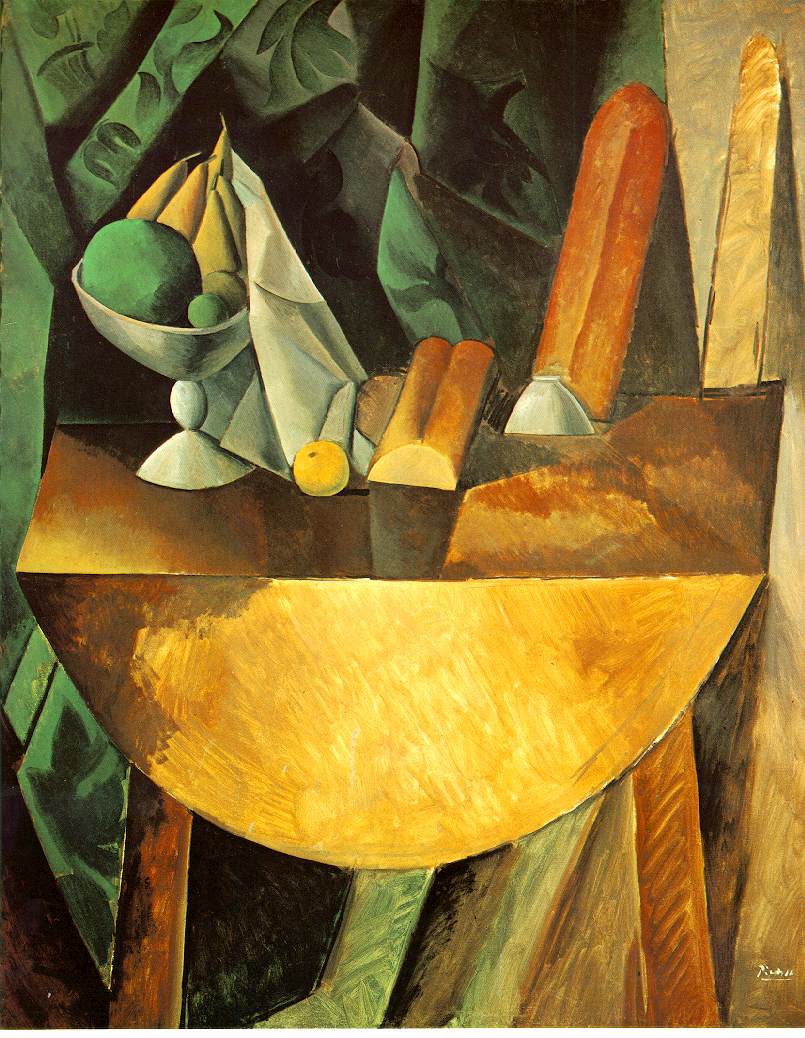
One of the aspects that change this painting from realistic paintings is the fact that it is painted from different angles. This can be seen in the picture as you can see multiple view points of the objects. Take the bananas for an example: there are multiple viewpoints present in the drawing. The contours are also very clear in the picture. This is both seen by differencing colours or a black line.

There are several aspects with this painting that can help me with future cubism drawings. One of the aspects that I can learn from is contours. This is because the picture has very clear contours and it can help me to find out what the major contours are.

Another aspect that can help me is the use of colour. This is because the painting really shows how colours can be used in Cubism or more specifically analytical cubism. It also shows how different viewpoint can be incorporated into a picture.

Cubism 27/10/11

During last lesson we continued our cubism unit. We started the lesson by watching parts of a film on Picasso. It was very usefull as we learnt allot on the method of cubism and we saw many different cubist paintings. When this was done we drew a painting when we drew with different angles. It was an analytic cubist drawing. During the painting we focused on the contours. With the drawing I am overall happy, but I believe the objects are not to well placed. It was very difficult.

This was the picture I drew. It was the most difficult drawing so far.

torsdag 20. oktober 2011

Cubism 20/10/11

Today we started a new unit about cubism. The first thing we did during this lesson was to discuss a few words that would be important to the cubism unit. This included "abstract (to remove), contour (edge) and still life (non-moving objects). We also had to draw a set of object and do several 'cubist activities' with it. This included us doing quick sketches with a lot of focus on the contour. We also did a sketch without looking at the drawing and ones where you had to change seat and continue your drawing from another perspective. The results were changeable. Overall I think I am going to apreciate this unit, even though I think it is going to be much harder than the previous unit.


Here is a picture of two drawings where we had to change our wiev of the picture.
I believe that the picture to the right is the most succsesfull.